Why Sweaty Hands and Feet Usually Come as a Pair
If your palms drip during meetings and your socks are damp by lunchtime, you are not dealing with two separate problems. Sweaty hands and feet almost always travel together, and there is a name for the combination: palmoplantar hyperhidrosis — excessive sweating of the palms (palmar) and soles (plantar).
Understanding why the two areas flare in tandem matters, because it changes how you treat them. Chasing hand sweating and foot sweating with two separate routines is slower, more expensive and usually less effective than picking treatments designed to cover both at once.
This page is only about the combination. Palms on their own: how to stop sweaty hands and the palmar hyperhidrosis guide. What to buy: sweaty hands and sweaty feet.
The Shared Mechanism: One Nerve Signal, Two Locations
Your palms and soles are unusual skin. They carry the highest density of eccrine sweat glands anywhere on the body — roughly 600–700 glands per square centimetre, several times more than your back or arms. Crucially, these glands respond primarily to emotional and nervous-system signals rather than heat. That is why your hands sweat before an interview but not necessarily on a hot day.
In primary focal hyperhidrosis, the sympathetic nervous system sends an exaggerated "sweat now" signal to these gland-dense areas. Because the palms and soles sit on the same overactive circuit and share the same gland distribution, they tend to switch on together. Flare-ups triggered by stress, concentration or anxiety typically hit both at once.
The classic profile of palmoplantar hyperhidrosis, described by the International Hyperhidrosis Society and NICE, looks like this:
- Starts young — usually in childhood or early adolescence, almost always before 25
- Often hereditary — a substantial proportion of sufferers have a close relative with the same condition
- Symmetrical — both hands and both feet, not one side
- Stops during sleep — night-time sweating suggests a different cause
- No underlying illness — it is a standalone condition, not a symptom
If your sweating appeared suddenly in adulthood, affects one side only, or happens at night, that pattern points away from primary hyperhidrosis — read our guide on when to see a doctor about sweating and book a GP appointment to rule out secondary causes.
Treatments That Cover Hands and Feet at Once
NICE's clinical knowledge summary starts with aluminium chloride for localised sweating, including hands and feet. Iontophoresis is the next option when that has failed or is unacceptable. The order below follows that, not a gadget-first list.
1. A 20% pharmacy antiperspirant on both areas
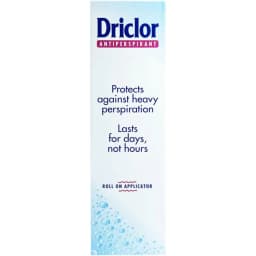
Driclor and Anhydrol Forte are roll-ons. Odaban is a spray, which is often easier on a sole and still usable on a palm. Apply to completely dry skin at night, including between the toes, and wash off in the morning. A pharmacist can sell them without a prescription.
Advertising disclosure: Driclor and Odaban may earn a commission via Amazon UK. Anhydrol Forte is a Chemist.net page, not an Associates link.
Driclor → | Anhydrol Forte → | Odaban →
Hands are washed all day, so night-time application matters even more than for underarms. Thick skin on palms and soles means the result is often more modest than under the arms. Many people take the edge off and still need the next step. That is normal. It is not a reason to skip this one.
2. Iontophoresis, one machine for both
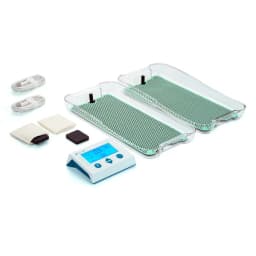
Iontophoresis passes a mild electrical current through tap water while your hands or feet soak in shallow trays. Published studies report high response rates for palmoplantar sweating. The figure depends on the current, the schedule and whether people keep the sessions up, so this page does not treat one percentage as a promise.
What a machine adds, once the pharmacy step has failed, is practical: one device treats both areas. Most home devices ship with trays sized for hands or feet, so you alternate — hands one session, feet the next, or both in the same sitting depending on the device. There is no per-area cost multiplication the way there is with, say, Botox (which is priced per area and rarely used on feet).
The trade-off is time. A typical protocol is 3–4 sessions of 20–30 minutes per week for the first few weeks, dropping to weekly or fortnightly maintenance once dryness kicks in. It is a commitment, but it is drug-free, and a machine bought once lasts years.
A machine comes after the pharmacy step, not before it. Dermadry's US clearance is not an NHS approval. The Dermadry Total is the home device this site links for hands and feet together. How it compares with the RA Fischer is on Dermadry vs RA Fischer, and the wider field is best iontophoresis machines. The same disclosure applies to those buying links.
3. Oral medication, via your GP, for severe cases
Because tablets work systemically, they are one of the few options that treat every sweating area simultaneously — hands, feet and anywhere else. Propantheline is the oral medicine licensed for hyperhidrosis in the UK. Oxybutynin is often used off-label. Both reduce the nerve signal to sweat glands body-wide. The choice and the dose belong to the prescriber.
These are prescription-only in the UK and come with trade-offs: dry mouth, dry eyes, and other anticholinergic side effects are common at effective doses. NICE guidance positions oral treatment as an option for severe or widespread hyperhidrosis when topical measures have failed, and it is a conversation to have with your GP or a dermatologist rather than a self-directed route. We cover the evidence in more depth in our guides to oxybutynin and glycopyrrolate.
4. Botulinum toxin is a poor fit for both areas
Injections can reduce palmar sweating for several months. They are a poor fit when feet are part of the problem: each area is treated separately, palm injections are painful, and soles are rarely offered. In the UK, hands and feet are seldom funded. Iontophoresis is the option that covers both without that split.
5. ETS Surgery — a Genuine Last Resort
Endoscopic thoracic sympathectomy (ETS) cuts or clamps the sympathetic nerves driving hand sweating. It is highly effective for palms — and this is where the honesty matters — much less reliable for feet, which are served by different nerves. Worse, it carries a substantial risk of compensatory sweating: new, sometimes severe sweating on the back, chest, or legs that many patients rate as worse than the original problem.
Because the procedure is largely irreversible, the British Association of Dermatologists and NHS guidance treat ETS surgery strictly as a final option after everything else has failed. For a condition affecting both hands and feet, it is doubly questionable: you accept the full surgical risk and may still be left with sweaty feet.
Comparison: Treatment Options for Hands + Feet
| Treatment | Covers hands? | Covers feet? | Effectiveness (palmoplantar) | Typical UK cost | Best for |
|---|---|---|---|---|---|
| 20% pharmacy antiperspirant | Yes | Yes, applied separately | Modest on thick skin; still the first step | Pharmacy price; check the retailer | Everyone, before a machine |
| Iontophoresis (home device) | Yes | Yes, same machine | High in published studies; protocol-dependent | See the product card | When the pharmacy step is not enough |
| Oral medication (GP) | Yes | Yes — systemic | Moderate–high, side effects common | Prescription | Severe or multi-area sweating |
| Botox injections | Yes | Rarely offered | High for palms; short-lived | £400–£800+ per area, repeated | Palms only, when iontophoresis fails |
| ETS surgery | Yes | Unreliable | High for palms; poor for feet; compensatory sweating risk | NHS referral / private | True last resort |
A Practical Routine for Both Areas
A sensible sequence for most people with combined sweaty hands and feet:
- Start cheap. Night-time aluminium chloride on palms and soles for 3–4 weeks. If that controls it, you are done.
- Step up to iontophoresis. If antiperspirants fall short, a home machine treating both areas is the logical next move — the Dermadry vs RA Fischer comparison will help you choose.
- Layer in area-specific tactics. Moisture-wicking socks, rotating shoes, and absorbent insoles make a real difference for feet alongside any treatment — our sweaty feet remedies guide covers the full toolkit, and the complete hand sweating guide does the same for palms.
- See your GP for severe cases. If sweating still disrupts work, grip, or footwear despite the above, ask about oral medication or a dermatology referral.
When to See a GP First
Skip straight to your GP — before buying anything — if your sweating started after age 25, appeared suddenly, affects one side only, happens during sleep, or comes with weight loss, fever or palpitations. These patterns suggest secondary hyperhidrosis, where treating an underlying cause is the real fix. The NHS also recommends seeing a GP whenever sweating is significantly affecting your daily life, whatever the pattern — effective prescription options exist, and you do not need to simply put up with it.
Sweaty hands and feet are one pattern, not two illnesses. Treat both with a 20% pharmacy antiperspirant first. Iontophoresis is the next step when that is not enough, because one machine can cover both areas.