What is iontophoresis?
Iontophoresis passes a mild electrical current through water and into the skin. It is used mainly for sweaty hands and feet, after a strong antiperspirant has not been enough.
In the UK, NICE's clinical knowledge summary starts with lifestyle advice and a 20% aluminium chloride hexahydrate antiperspirant (Driclor, Anhydrol Forte or Odaban). Iontophoresis is a later option. Some NHS dermatology departments run clinics for hands and feet; others do not, which is why people buy a home machine. That local variation is set out in our NHS treatment guide.
Published studies report high response rates for palmar and plantar sweating, but the figures depend on the protocol, the current and how long people keep up the sessions. This page does not treat a single percentage as a promise. The British Association of Dermatologists includes iontophoresis among treatments for hyperhidrosis. A US FDA clearance on a device is a US regulatory status, not an NHS recommendation.
How Does Iontophoresis Work?
The Science
The exact mechanism of action isn't fully understood, but the leading theory involves temporary disruption of the sweat gland's ion channel signaling. Here's how it works in practice:
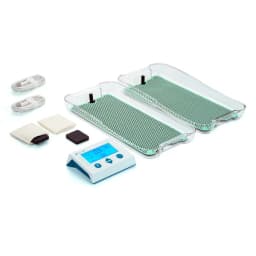
- You place the affected body part (hands, feet, or underarms with special pads) into shallow trays filled with tap water.
- The device passes a low-level direct electrical current (typically 15-25 mA) through the water.
- The current carries mineral ions from the water into the skin's outer layer (stratum corneum).
- These ions are believed to create a temporary blockade in the sweat duct, reducing the signal that triggers sweat production.
Research published in the British Journal of Dermatology suggests that iontophoresis may work through a combination of mechanisms: disrupting the electrochemical gradient necessary for sweat secretion, temporarily thickening the keratin layer that plugs sweat ducts, and altering the pH of the sweat gland environment.
What It Feels Like
During treatment, most people feel a mild tingling or prickling sensation in the submerged skin. It's not painful, though it can feel slightly uncomfortable at higher current settings. If you have any small cuts or abrasions on your hands or feet, you'll want to cover them with petroleum jelly before treatment, as broken skin can cause a stinging sensation.
The current level is adjustable on all quality devices, so you can find the intensity that's effective without being uncomfortable.
Effectiveness and Success Rates
Clinical Evidence
Iontophoresis has a robust body of evidence supporting its effectiveness:
- A systematic review in the Journal of the American Academy of Dermatology found tap water iontophoresis achieved an substantial response rate for palmar hyperhidrosis.
- A study published in Dermatologic Surgery reported that 91% of patients with palmar hyperhidrosis experienced significant improvement.
- Research in the British Journal of Dermatology showed 81% of patients with plantar hyperhidrosis achieved satisfactory results.
- For axillary hyperhidrosis, success rates are somewhat lower at substantial, but still significant.
Timeline to Results
Iontophoresis isn't an instant fix — it requires consistency during the initial treatment phase:
- Week 1-2: Initial treatment phase. Sessions every day or every other day. Most people don't notice significant changes yet.
- Week 2-4: Gradual drying begins. Many patients report their first noticeable improvement around days 10-14.
- Week 4-6: Full effect typically achieved. Sweating is substantially reduced in the treated areas.
- Ongoing: Maintenance sessions 1-3 times per week to sustain results.
The key word is consistency. People who follow the protocol diligently during the initial phase overwhelmingly succeed. Those who skip sessions or give up after a week often conclude the treatment "doesn't work" — when in reality, they didn't give it enough time.
Tap Water vs. Glycopyrrolate Solution
Tap Water Iontophoresis
Standard tap water iontophoresis is the first approach most people try, and for the majority, it's all that's needed. The mineral content of your tap water matters — harder water (higher mineral content) tends to produce better results because the ions that create the blocking effect are more abundant.
If your tap water is soft (low mineral content), you can:
- Add 1 teaspoon of baking soda per tray to increase conductivity
- Use mineral-enhanced water
- Add a small amount of aluminium chloride solution
Glycopyrrolate Iontophoresis
For people who do not respond adequately to tap water alone, some clinicians add glycopyrrolate, an anticholinergic, to the water. Reports suggest this helps some of those patients, though the evidence base is small.
This is not something to attempt yourself. Glycopyrrolate is prescription-only, the concentration matters, and adding medication to an iontophoresis bath is a clinical decision — speak to a dermatologist rather than sourcing it independently.
Iontophoresis Devices: What to Buy
Dermadry Total
The Dermadry Total is the most popular home iontophoresis device on the market, and for good reason. It treats hands, feet, and underarms, comes with an intuitive interface, and is more affordable than clinical-grade units.
Key specs:
- Current range: 0-15 mA (hands), 0-25 mA (feet), 0-4 mA (underarms)
- Pulsed and direct current options
- Treatment time: 20 minutes per session
- Price:
$500(about £372) from the manufacturer, before delivery and any import charges - The maker describes the device as FDA-cleared. That is a US device clearance
- Sold direct. Check whether it ships to the UK and what the return rules are
The Dermadry is an excellent starting point for most people. Its pulsed current option is particularly useful for those who find direct current uncomfortable.
RA Fischer MD-1a
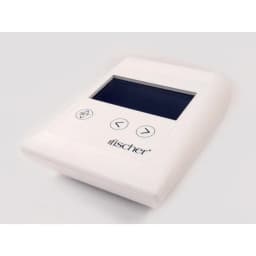
The RA Fischer MD-1a is the clinical-grade gold standard. Manufactured in the US, it's the device most commonly found in dermatology offices and has been in production for decades.
Key specs:
- Current range: 0-50 mA
- Direct current (DC) only
- Treatment time: 15-30 minutes per session
- Price:
$1075(about £799) from the manufacturer - Also described as FDA-cleared. Same point: that is not an NHS commissioning decision
- Made in the United States. UK buyers should confirm shipping and support before ordering
The RA Fischer's higher current capability makes it the better choice for severe cases or patients who haven't responded to lower-powered units. The trade-off is a higher price point and no pulsed current option.
Which Device Should You Choose?
For a detailed side-by-side comparison, see our guide to the best iontophoresis machines.
Choose the Dermadry Total if:
- You're trying iontophoresis for the first time
- Your hyperhidrosis is mild to moderate
- You want the most affordable option
- You prefer pulsed current (less tingling)
- You need underarm treatment capability
Choose the RA Fischer MD-1a if:
- You have severe hyperhidrosis
- You didn't respond to lower-powered devices
- You plan to use glycopyrrolate solution (higher current helps)
- You prefer a clinical-grade device
- Long-term durability is a priority
Treatment Protocol: Step by Step
This live demonstration from RA Fischer Co. shows a real hands-and-feet session on a clinical-grade device — useful context before the written protocol:
Initial Phase (Weeks 1-4)
- Fill the trays with tap water to a depth that covers the hands or feet. Water temperature should be comfortable — room temperature or slightly warm.
- Apply petroleum jelly to any cuts, hangnails, or broken skin.
- Place your hands or feet in the trays. Ensure good contact with the water.
- Start at a low current (5-8 mA for hands, 10-15 mA for feet) and gradually increase to your comfort level over the first few sessions.
- Treat for 20-30 minutes per session.
- Repeat every day or every other day for the first 2-4 weeks.
Finding Your Optimal Settings
- Start low: Begin at 5-8 mA and increase by 1-2 mA each session until you find your effective range.
- Target range: Most people find their sweet spot between 12-20 mA for hands and 15-25 mA for feet.
- More isn't always better: Cranking the current to maximum won't necessarily produce faster or better results, and it will be uncomfortable.
- Polarity matters: Switching polarity (reversing the positive and negative leads) halfway through the session can improve results and reduce skin irritation.
Maintenance Phase (Ongoing)
Once you've achieved dryness (typically after 2-4 weeks of daily sessions), you can reduce frequency:
- Week 5-6: Reduce to 3 times per week
- Week 7-8: Try 2 times per week
- Week 9+: Find your minimum effective frequency — most people maintain results with 1-3 sessions per week
Everyone's maintenance needs are different. Some people stay dry with a single weekly session; others need three. The goal is to find the least frequent schedule that keeps your sweating controlled.
Tips for Better Results
- Consistency beats intensity. Regular sessions at moderate current outperform sporadic sessions at high current.
- Treat at the same time each day to build it into your routine.
- Hard water helps. If your tap water is soft, add a teaspoon of baking soda per tray.
- Dry your skin thoroughly after treatment and wait 30-60 minutes before applying lotion or antiperspirant.
- Keep a log of your settings, frequency, and results to identify your optimal protocol.
Treating Different Body Areas
Hands (Palmar Hyperhidrosis)
Iontophoresis is most effective and most studied for palmar hyperhidrosis. The flat surface of the palms makes excellent contact with the water, and the sweat gland density in this area responds well to treatment. This is where you'll see the highest success rates.
Feet (Plantar Hyperhidrosis)
Slightly less effective than palmar treatment but still highly successful (approximately 81% response rate). The thicker skin on the soles may require slightly higher current settings. Many people treat hands and feet simultaneously using a device with multiple channels.
Underarms (Axillary Hyperhidrosis)
Underarm treatment requires special electrode pads rather than water trays. The results are good (a good success rate) but typically not as dramatic as palmar/plantar treatment. If you're primarily treating underarms, you might also consider Botox or miraDry as alternatives — our iontophoresis vs Botox comparison weighs the two head to head.
Face and Scalp
Iontophoresis for craniofacial hyperhidrosis is less common and more challenging to administer. Specialised electrode masks or pads are needed, and the treatment is typically done in a clinical setting rather than at home.
Side Effects and Safety
Iontophoresis has an excellent safety profile when used correctly. Side effects are generally mild and temporary:
Common Side Effects
- Mild tingling during treatment (expected and normal)
- Temporary skin dryness or peeling on treated areas
- Mild redness immediately after treatment (resolves within an hour)
- Small blisters in rare cases (usually from too-high current)
How to Minimise Side Effects
- Coat cuts and broken skin with petroleum jelly before treatment
- Increase current gradually over multiple sessions
- Use pulsed current if direct current causes discomfort
- Apply a gentle, fragrance-free moisturizer after treatment (wait 30 minutes)
Who Should NOT Use Iontophoresis
- Pregnant women (insufficient safety data)
- People with cardiac pacemakers or other implanted electronic devices
- People with metal implants in the treatment area (pins, plates)
- Those with epilepsy (without physician supervision)
Cost Comparison
In the UK: a home device costs roughly £350–900 once, while private clinic sessions run about £40–80 each — and you need eight to ten to load, then maintenance every one to four weeks. A device usually pays for itself inside the first year. Some NHS dermatology departments run iontophoresis clinics, though availability varies by area. See the UK treatment cost calculator.
The figures below are US market prices, included for reference.
Device Purchase (One-Time)
| Device | Cost | What's Included |
|---|---|---|
| Dermadry Total | Manufacturer price in the Dermadry section above | Hand and foot trays, underarm pads, device |
| RA Fischer MD-1a | Manufacturer price in the RA Fischer section above | Hand and foot trays, device |
| Hidrex PSP1000 | $650-$850 (about £483–632) | Hand/foot trays, device |
Ongoing Costs
- Tap water: Essentially free
- Glycopyrrolate solution (if needed): $30-$60/month (about £22–45) with prescription
- Replacement electrode pads (for underarm treatment): $20-$40 (about £15–30) every few months
- Electricity: Negligible
Compared to Other Treatments
Over a 5-year period, iontophoresis is dramatically less expensive than alternatives:
| Treatment | 5-Year Cost |
|---|---|
| Iontophoresis (home device) | $400-$1,100 (about £297–818) (one-time) |
| Botox | $5,000-$15,000 (about £3,718–11,156) |
| miraDry | $2,000-$3,000 (about £1,487–2,231) (one-time, underarms only) |
| Prescription medications | $600-$6,000 (about £446–4,462) |
| Clinical antiperspirants | $250-$1,000 (about £186–744) |
On the NHS
There is no NICE clinical guideline that sets a national iontophoresis service. NICE TA1175 covers glycopyrronium bromide cream for severe underarm sweating, not machines for hands and feet. What your area funds is still decided by the integrated care board. Ask your GP. The route is set out in hyperhidrosis treatment on the NHS.
Frequently Asked Questions
How long does it take for iontophoresis to work?
Most people begin noticing reduced sweating after 6-10 sessions (roughly 1-2 weeks of daily treatment). Full results typically take 2-4 weeks. Some people respond faster, while others need up to 6 weeks. The key is consistency — don't give up too early.
Can iontophoresis permanently cure sweaty hands?
Iontophoresis does not permanently cure hyperhidrosis. It provides excellent control as long as you maintain regular sessions. If you stop treatments entirely, sweating will gradually return — usually within 1-4 weeks. Think of it like exercise for your sweat glands: the results last as long as you keep up the routine.
Does iontophoresis hurt?
Most people describe the sensation as a mild tingling or buzzing. It should never be painful. If it is, your current is too high. People with sensitive skin or those just starting out may want to begin with pulsed current mode, which breaks the electrical current into intervals and feels gentler than continuous direct current.
Can I do iontophoresis at home?
Absolutely. Home iontophoresis is the standard approach. Devices like the Dermadry Total and RA Fischer MD-1a are specifically designed for home use. Initial in-office sessions with a dermatologist can be helpful to learn proper technique, but most patients quickly transition to self-treatment.
What if tap water iontophoresis doesn't work for me?
If tap water alone isn't producing results after 4-6 weeks of consistent daily treatment, there are several options: increase your water's mineral content with baking soda, try a higher-powered device, or ask your dermatologist about adding glycopyrrolate solution to the water. Glycopyrrolate iontophoresis has been shown to succeed in patients who didn't respond to tap water alone.
How often do I need to do iontophoresis?
During the initial treatment phase, daily or every-other-day sessions are recommended. Once you achieve dryness, most people can maintain results with 1-3 sessions per week. Your ideal maintenance frequency depends on your individual response and severity.
Can I treat hands and feet at the same time?
Yes, if your device has dual-channel capability or you have two devices. Many people treat both simultaneously to save time. A typical session treating both hands and feet takes about 20-30 minutes.
Is iontophoresis safe during pregnancy?
Iontophoresis is generally not recommended during pregnancy due to insufficient safety data, not because of known risks. Consult your OB-GYN before starting or continuing treatment if you're pregnant or planning to become pregnant.
Sources
- Stolman LP. "Treatment of hyperhidrosis." Dermatologic Clinics. 1998;16(4):863-869.
- Pariser DM, Ballard A. "Iontophoresis for palmar and plantar hyperhidrosis." Dermatologic Clinics. 2014;32(4):491-494.
- Dolianitis C, et al. "A treatment approach for hyperhydrosis with tap water iontophoresis." Australasian Journal of Dermatology. 2013;54(Suppl 1):26.
- Reinauer S, et al. "Iontophoresis with alternating current and direct current offset: a new approach for the treatment of hyperhidrosis." British Journal of Dermatology. 1993;129(2):166-169.
- Karakoc Y, et al. "Safe control of palmoplantar hyperhidrosis with direct electrical current." International Journal of Dermatology. 2002;41(9):602-605.
- International Hyperhidrosis Society. "Iontophoresis." www.sweathelp.org. Accessed March 2026.
Getting this treated in the UK
What the NHS will fund, what needs a referral and what you will have to pay for privately varies by area. Our guide to hyperhidrosis treatment on the NHS walks through the route from GP appointment to dermatology referral.