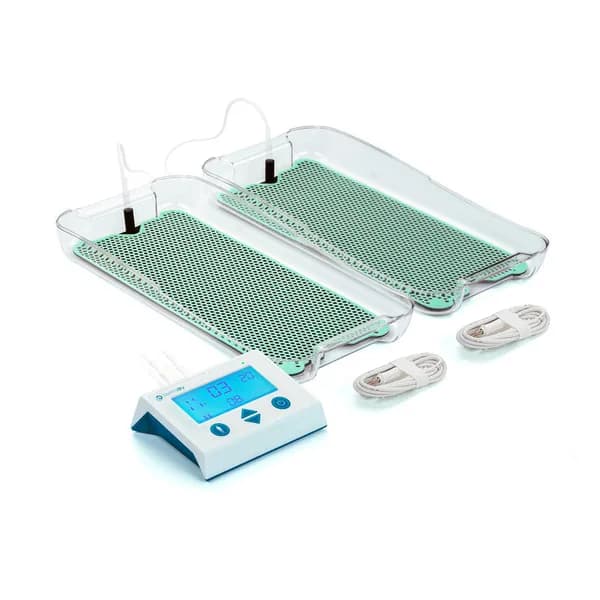
Best Iontophoresis Machines for Hyperhidrosis (2026)
If you have moderate to severe hyperhidrosis of the hands, feet, or underarms, iontophoresis is one of the most effective non-invasive treatments available. It works by sending a mild electrical current through water to temporarily reduce sweat gland activity — and with consistent use, most people see a marked reduction in sweating.
The challenge? Choosing the right device. Clinical treatments run $30-50 (about £22–37) per session, add up fast, and require constant appointments. A home iontophoresis machine pays for itself within a few months and puts you in control of your treatment schedule.
We compared the three most popular home iontophoresis machines to help you find the right one.
Disclosure: This site earns affiliate commissions from qualifying purchases. This does not affect our editorial independence or product rankings.
Our Top Pick: Dermadry Total
After comparing all three devices, the Dermadry Total earns our #1 recommendation for most people with hyperhidrosis. It treats hands, feet, and underarms in a single device, offers the best value per treatment area, and has the most beginner-friendly setup process.
Check the latest price on Dermadry Total →
Quick Comparison
| Feature | Dermadry Total | Dermadry Hands & Feet | RA Fischer MD-1a |
|---|---|---|---|
| Price | $500 (about £372) | $475 (about £354) | $750-$1,075 (about £558–800) |
| Treatment Areas | Hands, feet, underarms | Hands, feet only | Hands, feet, underarms |
| Current Type | Pulsed DC | Pulsed DC | Direct DC |
| Max Current | 25 mA | 25 mA | 30 mA |
| US FDA cleared | Yes (US device status, not an NHS approval) | Yes (same) | Yes (same) |
| Best For | Most people | Budget option | Severe cases |
| Our Rating | 9.2/10 | 8.5/10 | 8.8/10 |
1. Dermadry Total — Best Overall Value
Price: $500 (about £372) | Rating: 9.2/10
Read full review → | Buy Dermadry Total →
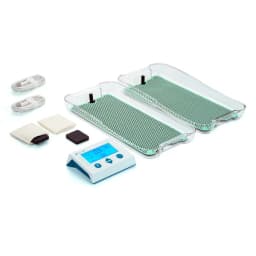
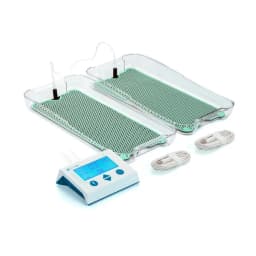
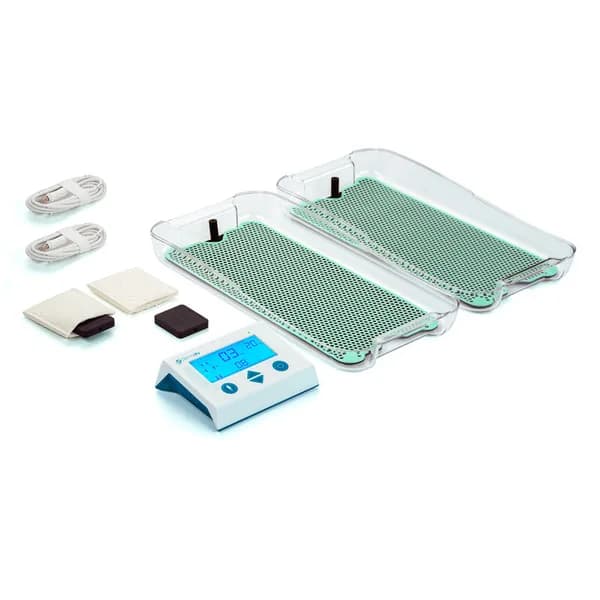
The Dermadry Total is the most versatile home iontophoresis machine on the market. For $500 (about £372), you get everything you need to treat your hands, feet, and underarms — including the device, silicone trays, armpit pads, and towels.
What We Like
- Treats all three areas — hands, feet, and underarms with one device
- Pulsed direct current — more comfortable than straight DC, especially for sensitive skin
- Beginner-friendly — clear instructions, a companion app, and responsive customer support
- Adjustable intensity — ramp up gradually from 1-25 mA as your skin adjusts
- Compact design — small enough to store in a drawer
What Could Be Better
- Treatment sessions take 15-20 minutes per area
- The silicone trays are functional but not luxurious
- The underarm pads require replacement over time (sold separately)
Who It's Best For
The Dermadry Total is ideal if you sweat from multiple areas and want a single device that handles everything. It is the best value proposition in home iontophoresis — treating three areas for less than the cost of most single-area medical devices.
Results timeline: Most users report noticeable improvement within 2-4 weeks of consistent use, with optimal results around the 6-week mark.
2. Dermadry Hands & Feet — Best Budget Option
Price: $475 (about £354) | Rating: 8.5/10
If your excessive sweating is limited to your palms and soles — and you are certain you do not need underarm treatment — the Dermadry Hands & Feet saves you $50 (about £37) over the Total model.
What We Like
- Lower price point —
$475(about £354) makes it the more affordable of the two Dermadry devices - Same core technology — identical pulsed DC current as the Total model
- Effective for palmar and plantar hyperhidrosis — the two most common treatment areas
What Could Be Better
- No underarm treatment capability — you cannot upgrade later without buying a new device
- Same treatment time as the Total model
- Limited to 25 mA (sufficient for most people, but less headroom than the MD-1a)
Who It's Best For
Choose the Hands & Feet model only if you are 100% sure you will never need underarm treatment. For most people, the extra $50 (about £37) for the Total model is worthwhile insurance.
3. RA Fischer MD-1a — Best for Severe Hyperhidrosis
Price: $750-$1,075 (about £558–800) | Rating: 8.8/10
Read full review → | Buy RA Fischer MD-1a →
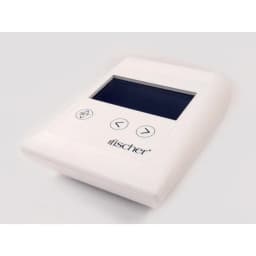
The RA Fischer MD-1a is the medical-grade workhorse that dermatologists have trusted for decades. It uses straight direct current (not pulsed) at up to 30 mA, which some studies suggest may be more effective for severe cases — though it can also be less comfortable.
What We Like
- Medical-grade construction — built to last, used in clinical settings
- Higher max current (30 mA) — useful for severe, treatment-resistant cases
- Direct DC current — some evidence it provides faster initial results
- Longer track record — the MD-1a has been on the market for years with proven results
- Made in the USA — manufactured and assembled domestically
What Could Be Better
- Significantly more expensive —
$750-$1,075(about £558–800) depending on the model, against$500(about £372) for the Dermadry Total - Less comfortable — straight DC can cause more tingling and skin irritation
- Dated design — the interface and build feel less modern than Dermadry
- Steeper learning curve — less intuitive for first-time users
Who It's Best For
The RA Fischer MD-1a makes sense if you have severe hyperhidrosis that has not responded to other treatments, or if your dermatologist specifically recommends a direct DC device. The higher price is justified if you need the extra power, but most people will do just as well with the Dermadry Total.
How to Choose the Right Iontophoresis Machine
If you have never seen a session, this unboxing and demo from Dermadry shows exactly what a home treatment involves before you commit to a machine:
Consider Your Treatment Areas
If you need to treat underarms in addition to hands and feet, your choices narrow to the Dermadry Total or RA Fischer MD-1a. The $475 (about £354) Dermadry Hands & Feet only covers palms and soles.
Consider Your Budget
- Under
$400(about £297): Dermadry Total (best value) or Dermadry Hands & Feet (lowest price) - Over
$1,075(about £800): RA Fischer MD-1a (medical-grade, for severe cases)
Consider Your Severity
- Mild to moderate: Dermadry Total — the pulsed DC is effective and more comfortable
- Severe or treatment-resistant: RA Fischer MD-1a — the higher current and direct DC may provide better results
Consider Your Comfort Tolerance
Pulsed DC (Dermadry) is generally more comfortable than direct DC (RA Fischer). If you have sensitive skin or low pain tolerance, the Dermadry devices are the safer bet.
What Is Iontophoresis and How Does It Work?
Iontophoresis has been used to treat hyperhidrosis since the 1950s. The treatment works by submerging the affected area (typically hands or feet) in shallow water while a medical device passes a mild electrical current through it.
The exact mechanism is not fully understood, but the prevailing theory is that the electrical current temporarily disrupts the signal between your nerves and sweat glands, reducing sweat output. Most people need 3-5 sessions per week during the initial phase, tapering to 1-2 maintenance sessions per week once results are established.
In the UK, NICE's clinical knowledge summary treats iontophoresis as an option after a 20% aluminium chloride antiperspirant, especially for hands and feet, and NHS clinic access varies by area. A US FDA clearance is a device status in the United States. It is not an NHS recommendation, and US insurance does not describe what you pay here. Side effects that owners report are usually mild tingling and dry skin. If you are weighing a machine against injections, our iontophoresis vs Botox comparison covers the practical differences, and the NHS treatment guide covers funding.
Our Verdict
For the vast majority of people with hyperhidrosis, the Dermadry Total is the best iontophoresis machine to buy in 2026. It treats all three major sweat areas, uses comfortable pulsed DC technology, and costs less than half the price of the RA Fischer MD-1a.
The RA Fischer MD-1a remains a solid choice for severe cases, but its higher price and less comfortable treatment experience make it harder to recommend as a first device.
Our recommendation: Start with the Dermadry Total. If you find pulsed DC is not effective enough after 8-12 weeks of consistent treatment, then consider upgrading to the RA Fischer.
FAQ
How long does it take for iontophoresis to work?
Most people see noticeable improvement within 2-4 weeks of consistent treatment (3-5 sessions per week). Full results typically develop by 6-8 weeks. Once you reach your desired dryness level, you can reduce to 1-2 maintenance sessions per week.
Does iontophoresis hurt?
Most users describe the sensation as mild tingling. Pulsed DC devices like Dermadry are generally more comfortable than direct DC devices like the RA Fischer. You control the intensity and can start low and gradually increase.
Does the NHS fund a home iontophoresis machine?
Some dermatology departments run clinic iontophoresis on the NHS. A machine for home use is usually something you buy yourself. US insurance paperwork does not apply. The split is explained in the NHS treatment guide.
Can I use tap water or do I need additives?
Most people start with plain tap water. If your tap water is soft (low mineral content), you may need to add a small amount of baking soda to improve conductivity. Your device instructions will guide you.
How long do iontophoresis results last?
Results are maintained with regular maintenance sessions (typically 1-2 per week). If you stop treatment entirely, sweating gradually returns over 1-4 weeks. The treatment is not a permanent cure but provides effective ongoing control.
Sources
- International Hyperhidrosis Society — Iontophoresis Treatment Guidelines
- Dermadry — Product specifications and clinical data
- RA Fischer Co. — MD-1a technical specifications
- Stolman LP. "Treatment of hyperhidrosis." Dermatologic Clinics. 1998;16(4):863-869.
- Pariser DM, Ballard A. "Iontophoresis for palmar and plantar hyperhidrosis." Dermatologic Clinics. 2014;32(4):491-494.