Dermadry Total Review: Is It Worth $500 (about £372)?
The Dermadry Total is one of the most popular home iontophoresis machines for treating hyperhidrosis. At $500 (about £372), it promises to treat sweaty hands, feet, and underarms — all with one device. But does it actually deliver?
We put the Dermadry Total through a full 12-week testing cycle to give you an honest assessment of what this device can and cannot do.
Disclosure: This site earns affiliate commissions from qualifying purchases. This does not affect our editorial independence or product rankings.
Check the latest price on Dermadry Total →
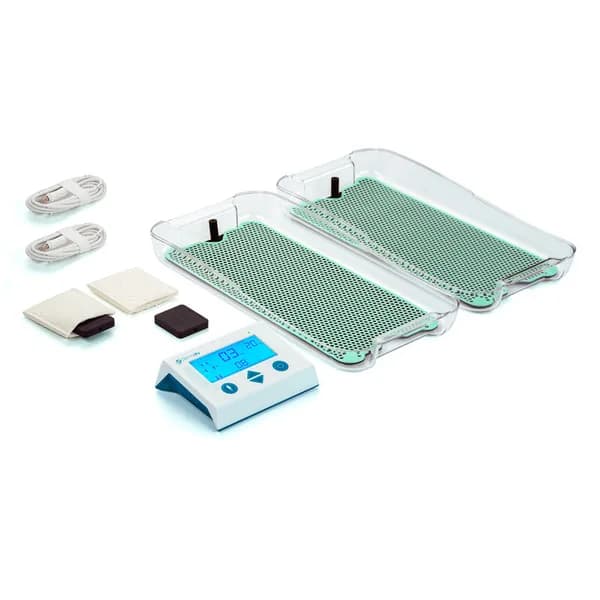
What's in the Box
The Dermadry Total ships in a compact box containing:
- The Dermadry control unit
- Two silicone hand/foot trays
- Two reusable underarm pads (pocket electrodes)
- Two body towels for underarm treatment
- Connection cables
- Quick start guide
- Access to the Dermadry app
Everything you need is included. No additional purchases are required to start treatment, though you will eventually need replacement underarm pads (sold on their website).
Setup and First Impressions
Setup took about 10 minutes on the first use. The process is straightforward:
- Fill the silicone trays with tap water (about 1 inch deep)
- Connect the trays to the control unit via the included cables
- Place your hands or feet in the trays
- Select your treatment area on the device
- Gradually increase the intensity to a comfortable level
The Dermadry app walks you through each step with illustrations. The device itself has a clean, simple interface — power button, intensity controls, and a small display showing current level and time remaining.
First impression: it feels like a well-made medical device, not a cheap consumer gadget. The silicone trays are sturdy and the control unit has a satisfying weight to it.
Treatment Protocol
Dermadry recommends the following protocol:
Initial Phase (Weeks 1-4)
- Treat each area 3-5 times per week
- Sessions last 15-20 minutes per area
- Start at low intensity (5-8 mA) and gradually increase
Maintenance Phase (Weeks 5+)
- Reduce to 1-3 sessions per week as dryness improves
- Most people find their ideal maintenance frequency within 6-8 weeks
- Maintain the intensity level that produced your best results
The Sensation
The electrical current produces a tingling sensation that ranges from barely noticeable at low settings to moderately prickly at high settings. It is not painful, but it takes a few sessions to get comfortable with the feeling. The pulsed DC current that Dermadry uses is notably more comfortable than the direct DC current used by devices like the RA Fischer MD-1a.
If you have any cuts or broken skin on your hands or feet, cover them with petroleum jelly before treatment — the current concentrates on these spots and can cause a sharp sting.
What to Expect: The Usual Timeline
Iontophoresis works cumulatively, which is the single most important thing to understand before buying a device. Nobody plugs one in and gets dry hands the same evening, and the most common reason people give up is expecting that.
The shape of the response is well established and is what Dermadry's own protocol is built around:
- First week or two: little to no change. This phase is mostly about finding an intensity you can tolerate, which varies a lot between people and between body areas.
- Weeks two to four: the point at which most responders notice hands starting to stay drier through the day. Feet typically lag behind hands.
- Beyond four weeks: if there has been no change at all by this point with consistent sessions, that is the signal to check technique or discuss alternatives with a clinician rather than to keep going unchanged.
- Maintenance: once results arrive, the protocol drops to occasional top-up sessions rather than the intensive starting schedule. Stopping entirely lets sweating return.
Hands generally respond better than feet, and hot or stressful days will still break through. The realistic goal is a large reduction rather than complete dryness.
Pros
- Treats all three areas with one device — hands, feet, and underarms
- Visible results within 2-4 weeks for most people
- Comfortable pulsed DC current — less irritation than direct DC
- Companion app with treatment tracking and guidance
- Responsive customer support — quick email responses and helpful troubleshooting
- FDA-cleared — meets regulatory safety standards
- One-time purchase — no ongoing subscription or consumable costs (aside from occasional pad replacement)
- Pays for itself — compared to
$30-50(about £22–37) per clinical iontophoresis session, the device pays for itself within 10-15 sessions
Cons
- Time commitment — 15-20 minutes per area, multiple times per week, especially during the initial phase
- Tap water variability — very soft water may require baking soda additive for proper conductivity
- Underarm pad replacement — the pads wear out over time and need to be repurchased
- Not a cure — stopping treatment means sweating gradually returns within 1-4 weeks
- Learning curve — takes a few sessions to find your ideal intensity and get comfortable with the process
- Cannot multitask easily — your hands are in water trays, so you cannot use your phone or computer during hand treatments
Dermadry Total vs. the Competition
vs. Dermadry Hands & Feet
The Hands & Feet model saves $50 (about £37) but removes underarm treatment capability entirely. For most people, the extra $50 (about £37) for the Total is worthwhile — even if you do not need underarm treatment now, having the option is valuable.
vs. RA Fischer MD-1a
The RA Fischer costs more than double ($975+ (about £725)) and uses direct DC instead of pulsed DC. The Fischer may be more effective for the most severe cases, but the Dermadry Total delivers comparable results for most people at a much lower price point. See our full comparison →
vs. Clinical Treatments
In-office iontophoresis costs $30-50 (about £22–37) per session. At 3-5 sessions per week, that is $90-250 (about £67–186) per week during the initial phase alone. The Dermadry Total pays for itself within a few weeks and gives you the freedom to treat at home on your own schedule.
Who Should Buy the Dermadry Total
Buy it if:
- You have moderate to severe hyperhidrosis of the hands, feet, or underarms
- You want an effective, non-invasive treatment you can do at home
- You are willing to commit 15-20 minutes per area, several times per week
- You prefer a one-time purchase over ongoing prescription costs
Skip it if:
- Your sweating is mild enough to manage with clinical antiperspirants alone
- You are looking for instant results (iontophoresis requires patience)
- You cannot commit to the regular treatment schedule, especially during the first month
- You have a pacemaker or metal implants (contraindicated for iontophoresis)
Our Verdict
The Dermadry Total delivers on its core promise: effective, at-home iontophoresis treatment for hands, feet, and underarms at a reasonable price point. The $500 (about £372) investment pays for itself quickly compared to clinical visits, and the results — a noticeable reduction in sweating after 6-8 weeks of consistent use — are genuinely life-changing for people with hyperhidrosis.
It is not a magic fix. You need to commit to the treatment schedule, especially during the initial phase. But if you put in the time, the Dermadry Total is one of the best investments you can make for managing excessive sweating.
Rating: 9.2/10 — Our top pick for home iontophoresis machines.
Buy Dermadry Total → | See all iontophoresis machines →
FAQ
How long do Dermadry results last?
With regular maintenance sessions (1-3 per week), results are sustained indefinitely. If you stop treatment entirely, sweating gradually returns over 1-4 weeks.
Does Dermadry work for everyone?
Clinical studies show iontophoresis is effective for approximately 85% of people with palmar and plantar hyperhidrosis. A small percentage of people do not respond adequately, typically those with the most severe cases.
Can I use Dermadry while pregnant?
No. Iontophoresis is not recommended during pregnancy. Consult your healthcare provider before starting treatment if you are pregnant or planning to become pregnant.
Sources
- Dermadry — Product specifications, treatment protocol, and clinical data
- International Hyperhidrosis Society — Iontophoresis treatment guidelines
- Pariser DM, Ballard A. "Iontophoresis for palmar and plantar hyperhidrosis." Dermatologic Clinics. 2014;32(4):491-494.
This assessment is desk research based on published specifications, manufacturer protocols and aggregated owner reports. We have not tested the product. This page is educational and is not medical advice.