If you sweat heavily, underarm stains are a laundry problem that keeps coming back. This guide covers both halves of it: getting out the yellow marks and white deodorant streaks you already have, and cutting down how many new ones form.
This is desk research. The methods come from the American Cleaning Institute (ACI), two US university extension services, the International Hyperhidrosis Society (IHS) and a textile-engineering study, and each step names its source. We have not washed or tested anything ourselves.
We may earn commission from qualifying purchases through our buying links. See our affiliate disclosure.
What yellow underarm stains are
Textile engineers at Istanbul Technical University describe the mechanism in a 2017 conference paper on underarm stain removal. Antiperspirants based on aluminium chloride or related aluminium compounds react with sweat and skin oil (sebum) to form a gel-like substance that dissolves poorly in water. On the skin, that gel is what blocks the sweat ducts. When it transfers to a shirt, it leaves yellowish marks that the authors say are very hard to remove with a normal machine wash.
Sweat on its own can stain too. A University of Kentucky Cooperative Extension leaflet notes that perspiration stains can be invisible at first, then oxidise and turn yellow over time, and that untreated stains can damage silk. University of Georgia (UGA) Extension adds that antiperspirants containing aluminium chloride are acidic and can change the colour of some dyes. That is why a coloured shirt can end up with a faded patch under the arm.
In practice there are two different problems:
- Yellow build-up on white and light shirts. Antiperspirant residue, sweat and skin oil that have settled into the fabric and yellowed over time.
- White marks on dark shirts. Deodorant or antiperspirant that has rubbed onto the fabric. ACI treats these as deodorant stains, with separate advice for light and heavy marks.
Check the care label first
ACI says to launder according to the fabric care instructions, and UGA says its methods apply only to washable items, not garments labelled dry clean only. Three more cautions from the same sources:
- Test first. UGA advises trying any cleaner on a hidden area, such as an inside seam, before you treat the stain.
- Keep ammonia off silk and wool. UGA warns that ammonia damages both.
- Never mix chlorine bleach with ammonia. ACI and IHS both warn that the combination gives off hazardous fumes.
For dry-clean-only garments, point the stains out to the cleaner. The Kentucky leaflet says cleaners have special treatments but may ask you to sign a consent form, because these can shrink some fabrics or change their texture. IHS suggests asking the cleaner to pre-treat the underarms.
How to get sweat stains out of white shirts
This sequence combines ACI's perspiration-stain steps with the IHS laundry guidance.
- Act early. ACI says the less time a stain has to soak in, the easier it is to remove. IHS suggests rinsing the underarms in cold water as soon as possible after you take the shirt off.
- Pre-treat from the inside. Turn the shirt inside out (IHS). Apply a prewash stain remover or rub the area with bar soap (ACI). IHS also lists detergent, white vinegar, a bleach stick or hydrogen peroxide as pre-treatments, and suggests leaving the garment for 30 minutes before washing.
- Wash hot, within the label. ACI and IHS both advise the hottest water the fabric will tolerate. IHS adds that some detergents are now made to work best in cold water, so check your detergent's directions too.
- Add an enzyme or oxygen product for stubborn stains. ACI says stubborn perspiration stains may respond to a product containing enzymes or oxygen bleach. IHS also suggests soaking the garment in water with an enzyme laundry product.
- Check before you dry. ACI, IHS and the Kentucky leaflet all say to keep the garment out of the tumble dryer until the stain has gone, because the heat sets it. If any yellow remains, repeat from step 2.
UK and US shops label the same product types differently:
- Oxygen bleach usually means sodium percarbonate. In the US the best-known brand is OxiClean, whose maker names sodium percarbonate as its key ingredient. In the UK, Vanish Oxi Action lists oxygen-based bleaching agents on its pack and describes itself as free of chlorine bleach. Its usage advice says not to use it on wool, silk, leather or dry-clean-only garments.
- Enzyme detergent is sold in the UK as "biological" detergent. Persil explains that most biological detergents contain protease and lipase enzymes, and non-biological versions leave them out.
Where the sources disagree on chlorine bleach
ACI recommends oxygen bleach for heavy deodorant stains, and enzymes or oxygen bleach for stubborn perspiration stains. It does not list chlorine bleach for either. UGA lists chlorine bleach, sodium perborate or hydrogen peroxide as follow-up options for a washable garment whose stain survives laundering. If you use chlorine bleach, do so only where the care label permits it, and never on a garment you have just treated with ammonia. Sweat-proof undershirts are a separate case, because Thompson Tee and Ejis both advise against bleach on their garments.
What one lab study found
The Istanbul team stained white cotton with three commercial antiperspirants and compared eight washing programmes. An oxygen-based pre-treatment (Vanish Oxi Action) clearly improved removal of one product's stains and reduced removal of another's. The authors concluded that wash temperature, tested at 40°C and 60°C, had no significant effect overall, and that temperature can be chosen from the care label. A single lab simulation cannot predict how your shirt will respond. It does suggest trying a different pre-treatment if the first one does nothing, and it gives no reason to wash hotter than the label allows.
Old, set-in yellow stains
If the fabric itself has changed colour, ACI says to apply ammonia to fresh stains or white vinegar to old stains, then rinse. The Kentucky leaflet specifies diluted ammonia or a solution of white vinegar and water, rinsed well before washing. UGA suggests a few drops of either. IHS notes that old stains have already oxidised, which is why it no longer recommends ammonia for them, so vinegar is the option for marks that have been through several washes.
After that, wash as above with an enzyme or oxygen bleach product and let the shirt air-dry. Expect to repeat the treatment. The Istanbul authors describe aluminium-based underarm stains as very hard to remove by machine washing, so a shirt that has yellowed over months may need several rounds.
Deodorant marks on dark shirts
ACI's deodorant advice depends on how heavy the mark is:
- Light marks: pre-treat with liquid laundry detergent, then wash.
- Heavy marks: apply a prewash stain remover, leave it for 5 to 10 minutes, then wash using an oxygen bleach.
On dark or coloured fabric, check that the oxygen product is labelled safe for colours and test it on a hidden seam first. UGA warns never to iron or apply heat to a deodorant stain, because heat combined with the chemicals can ruin most fabrics. If an underarm has faded or changed colour, the ammonia or vinegar step above is the one these sources suggest for restoring it.
To prevent white marks, IHS advises applying antiperspirant in a thin layer and letting it dry before you put your shirt on.
Collars, cuffs and hats
ACI calls the ring of grime inside a collar "collar and cuff soil". Its method is to pre-treat with a prewash stain remover, liquid laundry detergent or a paste of powder detergent and water, then wash. If your collars stain because your neck sweats heavily, our neck sweating guide covers that area.
For a cap or hat, read the care label before getting it wet. If washing is allowed, a stained sweatband is a perspiration stain, so ACI's perspiration steps apply, and keep it away from dryer heat until the stain has gone.
How to stop new stains
Apply antiperspirant at night and let it dry
IHS says bedtime application has been shown to be more effective than morning application, and that it keeps product off your clothing. You can still shower in the morning. The American Academy of Dermatology (AAD) gives the same timing for prescription antiperspirants: apply before bed, to dry skin. IHS also recommends a thin layer, one swipe up and one swipe down, and letting it dry before you dress.
There is a trade-off. The aluminium compounds that make antiperspirant work are the same ones the Istanbul study links to yellow staining, so the aim is the right amount at the right time, kept off fabric. A plain deodorant targets odour and does not reduce sweating. Our guide to antiperspirant vs deodorant explains the difference.
Put a barrier between skin and shirt
The NHS lists armpit or sweat shields among pharmacy products that protect clothing, the AAD suggests underarm or dress shields, and IHS recommends undershirts or dress shields. There are two main formats:
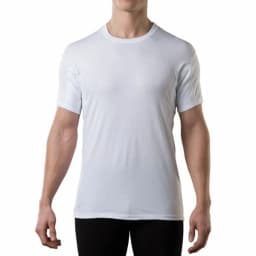
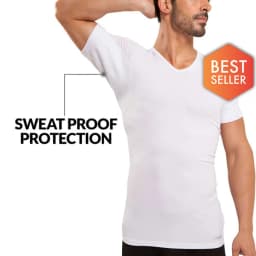
- Sweat-proof undershirts with built-in underarm panels. Thompson Tee says its Hydro-Shield panels stop sweat reaching the outer shirt, and Ejis describes a waterproof layer in its underarm panels. Both are manufacturer claims, and both cover the underarms only. Our sweat-proof undershirt guide compares fabric, fit and coverage, the Thompson Tee vs Ejis comparison goes variant by variant, and the Thompson Tee review covers sizing and returns.
- Underarm sweat pads that stick inside a shirt or to the skin. They suit occasional cover, and our underarm sweat pads guide compares disposable and reusable types.
Wash an undershirt according to its own label. Both brands advise against bleach, so the bleach steps in this guide are for your outer shirts.
Wear and wash habits
IHS says washing sweaty clothes as soon as possible after wearing them helps. The NHS suggests loose-fitting clothes to minimise signs of sweating, and avoiding tight clothes and synthetic fabrics such as nylon.
When stains are a sign to see a doctor
If stained shirts are a weekly event, the sweating itself may be worth treating. The NHS advises seeing a GP if you sweat excessively and self-help is not working, it has lasted at least six months, it stops you getting on with daily activities, it happens at least once a week, it happens at night, you have a family history of excessive sweating, or you take medicine for another condition. A pharmacist can suggest stronger antiperspirants in the meantime. In the US, a primary care doctor or a dermatologist is the place to start.
Our guide on when to see a doctor about sweating explains what to expect and the treatments that go beyond antiperspirant.
This page is educational and does not replace medical advice. See our disclaimer.