RA Fischer MD-1a Iontophoresis Review
The RA Fischer MD-1a is the medical-grade iontophoresis device that dermatologists have been prescribing for decades. While the Dermadry Total has become the popular home-use choice, the MD-1a remains the go-to recommendation from many hyperhidrosis specialists — particularly for severe cases that need maximum treatment power.
At $975+ (about £725), it costs more than double the Dermadry. We put it through a full evaluation to determine whether that premium is justified.
Disclosure: This site earns affiliate commissions from qualifying purchases. This does not affect our editorial independence or product rankings.
Check the latest price on RA Fischer MD-1a →
What Makes the MD-1a Different
The fundamental technical difference between the RA Fischer MD-1a and consumer devices like Dermadry is the type of electrical current:
- RA Fischer MD-1a: Direct DC (continuous direct current)
- Dermadry: Pulsed DC (direct current delivered in pulses)
Some clinical studies suggest that continuous direct current may be more effective at blocking sweat glands, particularly in treatment-resistant cases. The trade-off is that direct DC is less comfortable — the constant current produces a stronger tingling sensation compared to the intermittent pulses of the Dermadry.
Other Technical Specs
| Spec | RA Fischer MD-1a |
|---|---|
| Current type | Direct DC |
| Max current | 30 mA |
| Treatment areas | Hands, feet, underarms |
| FDA cleared | Yes |
| Made in | USA |
| Warranty | Limited lifetime |
| Price | $975+ (about £725) |
Setup and First Impressions
The MD-1a ships with:
- The MD-1a control unit
- Aluminium electrode trays
- Felt pads for the trays
- Connection cables and leads
- Instruction manual
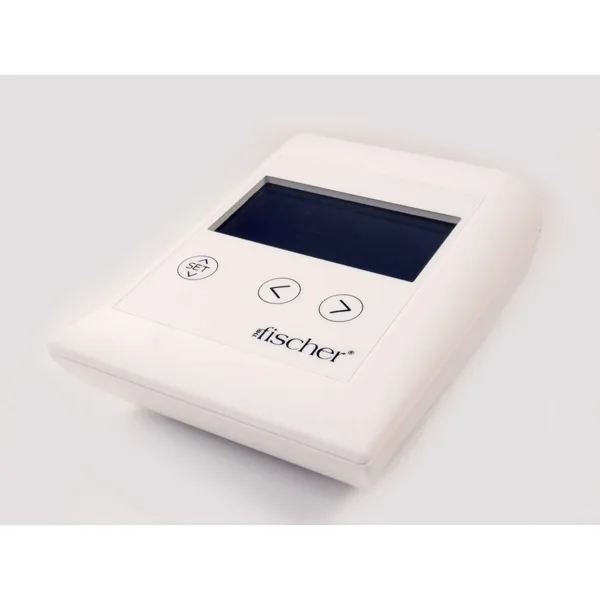
The device itself looks and feels like a piece of medical equipment. The control unit is larger and heavier than the Dermadry, with a more clinical aesthetic. There is no app, no Bluetooth, no modern interface — just a straightforward dial and display for current control.
Setup requires:
- Place felt pads in the aluminium trays
- Fill trays with tap water (just enough to cover the felt)
- Connect trays to the control unit
- Place hands or feet in the trays
- Gradually turn up the current dial to a comfortable level
The manual is adequate but less beginner-friendly than Dermadry's app-guided process. If you are doing iontophoresis for the first time, expect a bit more trial and error finding your ideal settings.
Treatment Protocol
The RA Fischer recommended protocol is similar to other iontophoresis devices:
Initial Phase (Weeks 1-6)
- Treat each area 3-5 times per week
- Sessions last 15-20 minutes per area (some dermatologists recommend up to 30 minutes for severe cases)
- Start at 10-12 mA and increase gradually
- Maximum recommended current: 25 mA for hands, 30 mA for feet
Maintenance Phase
- Reduce to 1-3 sessions per week based on your response
- Maintain the intensity level that produced your results
- Most people find their maintenance sweet spot within 8-12 weeks
The Treatment Experience
The direct DC current produces a stronger sensation than Dermadry's pulsed current. Here is what to expect:
- Low intensity (5-10 mA): Mild tingling, barely noticeable
- Medium intensity (10-18 mA): Definite tingling, slightly prickly but tolerable
- High intensity (18-25+ mA): Strong tingling approaching the edge of discomfort. Some people describe it as a mild prickling or burning sensation.
The sensation is not painful for most people, but it is noticeably more intense than pulsed DC at equivalent current levels. If you have sensitive skin or low pain tolerance, this is worth considering — the Dermadry is meaningfully more comfortable.
Cuts and abrasions: As with any iontophoresis device, cover any cuts, hangnails, or broken skin with petroleum jelly before treatment. The current concentrates on these points and can cause a sharp sting.
What to Expect
The response pattern for iontophoresis is the same whichever device delivers it, and it is gradual:
- First fortnight: usually no change. These sessions are about finding a tolerable current, which differs between hands and feet and between people.
- Weeks three to six: where most responders report hands beginning to stay dry through situations that would previously have triggered heavy sweating. Feet consistently lag behind hands.
- Beyond six weeks: peak effect for those it works for, after which session frequency drops to a maintenance schedule.
- Maintenance: typically a couple of sessions a week. Stopping altogether allows sweating to return.
The Fischer's selling point over cheaper devices is its higher available current and its build, which matters most to people who have plateaued on a lower-powered machine. We cannot tell you it outperforms a Dermadry from direct comparison, because we have not run one. Judge it on specification, warranty and support.
RA Fischer vs. Dermadry
This is the comparison everyone wants to see. Here is our honest assessment:
| Category | RA Fischer MD-1a | Dermadry Total |
|---|---|---|
| Price | $975+ (about £725) | $500 (about £372) |
| Current type | Direct DC | Pulsed DC |
| Max current | 30 mA | 25 mA |
| Comfort | More intense | More comfortable |
| Results (moderate cases) | Excellent | Excellent |
| Results (severe cases) | Slightly better | Very good |
| Ease of use | Steeper learning curve | Beginner-friendly (app) |
| Build quality | Medical-grade | Consumer-grade (solid) |
| Design | Clinical / dated | Modern / compact |
| Warranty | Limited lifetime | Standard |
The Honest Assessment
For 80%+ of people with hyperhidrosis, the results from both devices are comparable. The RA Fischer's advantage shows primarily in:
- Severe, treatment-resistant cases — the higher max current and direct DC can push through where pulsed DC plateaus
- Users who tolerate the sensation — if comfort is not a concern, direct DC may work slightly faster
- Long-term durability — the medical-grade build quality and limited lifetime warranty suggest greater longevity
For everyone else, the Dermadry Total provides 90-95% of the results at 40% of the price.
Pros
- Medical-grade construction — built to last decades, not years
- Higher max current (30 mA) — more headroom for severe cases
- Direct DC current — some evidence of superior efficacy for treatment-resistant hyperhidrosis
- Limited lifetime warranty — the company stands behind the product
- Made in the USA — domestic manufacturing and support
- Dermatologist recommended — the most prescribed home iontophoresis device
- Insurance potential — more likely to be covered as a medical device
Cons
$975+(about £725) is a significant investment — more than double the Dermadry Total- Less comfortable — direct DC produces stronger tingling than pulsed DC
- Dated design — the interface and aesthetics feel like a product from a previous era
- No app or digital guidance — steeper learning curve for first-time users
- Larger and heavier — less portable, harder to store discreetly
- Results are comparable to Dermadry for most people — the premium price does not guarantee proportionally better results
Who Should Buy the RA Fischer MD-1a
Buy it if:
- You have severe hyperhidrosis that has not responded adequately to other treatments
- Your dermatologist specifically recommends a direct DC device
- You want maximum treatment power and do not mind the stronger sensation
- Insurance will cover it (making the price difference irrelevant)
- You value medical-grade build quality and a long warranty
Skip it if:
- You have mild to moderate hyperhidrosis (the Dermadry Total is a better value)
- Comfort during treatment is important to you
- Budget is a factor (the Dermadry achieves comparable results at
$500(about £372)) - You are new to iontophoresis and want a more guided experience
- You want a compact, modern device
On the NHS
There is no national NICE guideline for hyperhidrosis, so what is funded beyond first-line antiperspirant is decided locally by your Integrated Care Board. That is why availability genuinely varies by area. Your GP is the route to finding out what yours commissions — see our guide to hyperhidrosis treatment on the NHS.
Our Verdict
The RA Fischer MD-1a is an excellent iontophoresis device that delivers strong results, especially for severe cases. The medical-grade build quality, higher max current, and direct DC technology give it a genuine edge for the most treatment-resistant patients.
However, for the majority of people with hyperhidrosis, the Dermadry Total provides comparable results at $500 (about £372) — less than half the price. We recommend starting with the Dermadry and upgrading to the MD-1a only if you need more power after 8-12 weeks of consistent treatment.
The exception: if you are in the US and your insurance covers the MD-1a, buy it. At copay prices there is no reason not to get the more powerful device.
Rating: 8.8/10
Buy RA Fischer MD-1a → | See all iontophoresis machines →
FAQ
Is the RA Fischer MD-1a worth the extra cost over Dermadry?
For most people, no — the Dermadry Total provides comparable results at a much lower price. The MD-1a is worth the premium for severe, treatment-resistant cases or when insurance covers the cost.
How long does the RA Fischer last?
The medical-grade construction and limited lifetime warranty mean the device should last many years — potentially 10+ years with proper care. This contrasts with consumer devices that may need replacement after 3-5 years.
Can I switch between direct DC and pulsed DC?
The MD-1a uses direct DC only. If you want to try pulsed DC, you would need a separate device like the Dermadry. Some dermatologists recommend trying both to see which works better for your specific physiology.
Sources
- RA Fischer Co. — MD-1a product specifications and treatment guidelines
- International Hyperhidrosis Society — Iontophoresis device recommendations
- Pariser DM, Ballard A. "Iontophoresis for palmar and plantar hyperhidrosis." Dermatologic Clinics. 2014;32(4):491-494.
- Dolianitis C, et al. "A comparison of pulsed and direct iontophoresis." Australasian Journal of Dermatology. 2004;45(2):140-141.
This assessment is desk research based on published specifications, manufacturer protocols and aggregated owner reports. We have not tested the product. This page is educational and is not medical advice.