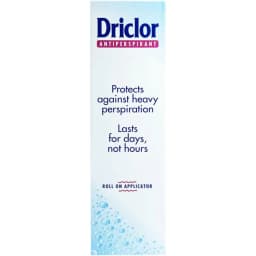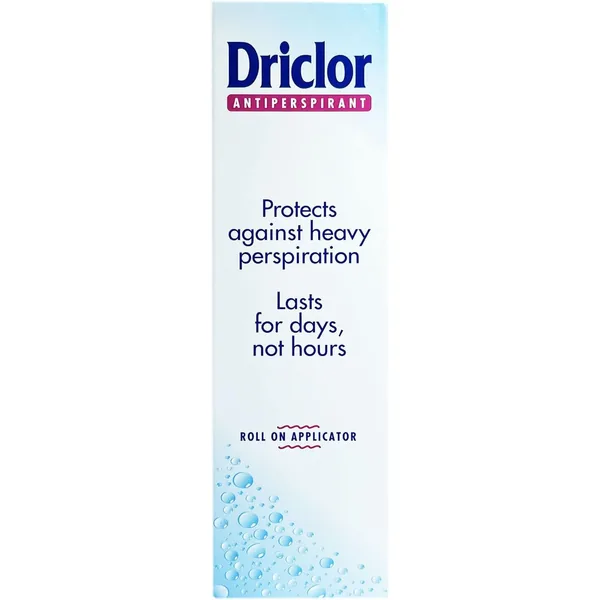
Driclor is the name most UK doctors and pharmacists reach for when someone asks about serious antiperspirants. It has been around for decades, it contains 20% aluminium chloride hexahydrate — the classic clinical-strength dose — and it is a licensed pharmacy medicine rather than a cosmetic. It is also famous for two things: working remarkably well, and stinging like mad when you use it wrong.
This Driclor review is based on the documented evidence — the licensing information, the manufacturer's usage instructions and thousands of aggregated user reviews — plus what dermatology guidance says about aluminium chloride for excessive sweating. No hype, and no pretending the sting away.
Disclosure: This site earns affiliate commissions from qualifying purchases. This does not affect our editorial independence. See our disclaimer.
Check the latest Driclor price on Amazon UK →
Boots (not an affiliate link): Driclor roll-on at Boots. Confirm the pack size on that page. The Amazon link is the Associates hop (amazon.co.uk, tag hyperhidrosisrelief-21). The Boots link has no tracking ID.
What Is Driclor?
Driclor is a roll-on antiperspirant designed to treat heavy sweating, the medical condition known as hyperhidrosis. It was created by Stiefel Laboratories, a British dermatology company acquired by GSK in July 2009, and is now marketed in the UK by Haleon — the consumer health business GSK spun off in 2022. Older packs still say "Stiefel, a GSK company", which is one reason people wonder whether the brand is still going. It is.
Product details at a glance:
- Active ingredient: Aluminium chloride hexahydrate 20% w/w
- Format: Roll-on only (no spray or stick)
- Pack sizes: 20ml and 75ml (the 60ml pack was discontinued in June 2026)
- Legal status: Pharmacy medicine — sold OTC through pharmacies, no prescription needed
- Licensed for: Underarms, hands and feet
- Amazon UK ratings: 4.5★ across more than 8,300 reviews (20ml); 4.6★ across 665+ reviews (75ml)
That last line matters. Very few products in this category have review volumes that large with averages that high. Whatever its comfort issues, an awful lot of people with excessive sweating clearly find Driclor solution worth the trouble.
How Driclor Antiperspirant Works
Driclor works by forming a gel matrix inside the sweat ducts. When the solution meets the small amount of moisture in the duct, it creates a temporary gel plug, which reduces the flow of sweat to the skin in the treated areas. With consistent nightly use, many people find those areas much drier within days to weeks. That is not guaranteed: some people only partly improve, and some stop because the solution irritates their skin.
Two useful consequences follow from that mechanism:
- The blockage builds up over time. Each application reinforces the plugs, which is why the routine starts nightly and then tapers down. Most users report a considerable improvement within one to two weeks.
- It is not permanent. The plugs shed naturally as your skin renews itself, so you reapply a couple of times a week to maintain dryness. Stop entirely and the perspiration returns within a week or two.
Note that Driclor is an antiperspirant, not a deodorant — it stops sweat rather than masking odour. The manufacturer recommends you continue to use your regular deodorant in the morning for daytime freshness.
For context on how this product class compares with prescription options, iontophoresis and Botox, see our guide to clinical antiperspirants.
Is Driclor Discontinued?
Short answer: no — Driclor has never been discontinued brand-wide in the UK. The rumour refuses to die, so here is where it actually comes from.
First, ownership changes created gaps on shelves. Driclor passed from Stiefel to GSK in 2009, then to Haleon when GSK demerged its consumer health division in July 2022. Intermittent UK stock shortages around those handovers left empty shelves and "out of stock" pages that looked, to worried users, like a quiet withdrawal.
Second, Driclor genuinely was withdrawn from the Australian market, and Australian forum posts about it circulate widely. Most "Driclor discontinued" posts you will find trace back to Australia, not the UK.
Third, there is a real 2026 change that is feeding the rumour a fresh news cycle: Haleon discontinued the 60ml pack with effect from 1 June 2026, confirmed in an NHS Business Services Organisation letter. The 20ml and 75ml packs remain available. One practical knock-on: NHS prescriptions written generically for "aluminium chloride 20% solution 60ml" now point to Anhydrol Forte as the reference product instead. We compare the two directly in Anhydrol Forte vs Driclor.
So in 2026, Driclor is alive and on UK pharmacy shelves under Haleon — just in two pack sizes rather than three.
Using Driclor Properly
Most Driclor horror stories are application errors. The way to use Driclor antiperspirant is a strict night-time routine:
- Apply at bedtime to completely dry skin. Towel off after washing, then wait — bone dry means bone dry.
- Use a thin layer. A few strokes of the roll-on per armpit. More product means more irritation, not more dryness.
- Let it dry before dressing or lying down.
- Wash it off with soap and water in the morning, then use your regular deodorant as normal.
- Repeat nightly until sweating is controlled, then reduce applications to twice a week, or as needed.
- Never apply after shaving. No shaving or depilatory creams within 12 hours of application, and never use it on broken skin, or near the eyes, nostrils or mouth.
The dry-skin rule is the whole game. Aluminium chloride reacting with water produces traces of hydrochloric acid — that is the chemistry behind the burn. Apply Driclor to damp armpits and you have brewed a mild acid against your skin; apply it when the skin is completely dry, at night when sweat glands are quietest, and many users report little more than mild tingling when it is first applied.
This short video from Carpe explains the night-time application logic that applies to every aluminium chloride product, Driclor included — it is the single biggest fix for people who think the product "does not work":
Driclor Side Effects
Honesty time: Driclor is the harshest of the mainstream UK antiperspirants, and the manufacturer's own guidance says it may cause irritation. Expect some or all of the following, worst in week one:
- A stinging sensation or burning on application — the most common complaint by far
- Itching, during the night or the next morning
- Redness, usually settling within hours
- Peeling or soreness with overuse
Managing it is straightforward. Make sure your skin is genuinely dry before every application, skip a night rather than pushing through soreness, and drop back to alternate nights while your skin adjusts. If overuse leaves you with sore, inflamed skin, a pharmacist can advise on a mild hydrocortisone cream. Speak to your GP if irritation persists, if the skin breaks, or if sweating remains uncontrolled despite several weeks of correct use — our guide to NHS hyperhidrosis treatment explains what the next steps look like.
If you have genuinely sensitive skin, the sting maths may simply not work in Driclor's favour — see the alternatives below.
Price and Where to Buy Driclor
Driclor is sold through UK pharmacies and online pharmacy retailers. Verified prices at the time of writing:
| Pack | Retailer | Price |
|---|---|---|
| 20ml | Hightown Pharmacy | £6.99 |
| 75ml | Remedime | £12.50 |
Boots also stocks the 20ml bottle in store and online. The 75ml bottle is much better value per millilitre, and because maintenance use is only a couple of times a week, one bottle lasts months. To buy Driclor online at today's price:
Check the latest Driclor price →
Driclor vs the Alternatives
Driclor is the benchmark, but it is not the only option — and for two specific groups of people, it is not the best one.
Anhydrol Forte — same strength, roughly a third of the price
Anhydrol Forte contains the identical active at the identical concentration: aluminium chloride hexahydrate 20%. It is also a pharmacy medicine, made by Dermal Laboratories, and since June 2026 it is the NHS reference product for generic 20% prescriptions. At £4.69 for 60ml from Express Chemist versus £6.99 for Driclor's 20ml, the price gap is enormous. If you just want 20% aluminium chloride at the lowest cost, Anhydrol Forte is the rational buy; Driclor's advantages are wider retail availability and the larger 75ml bottle.
Perspirex — the gentler option
Perspirex takes the opposite trade. It is a cosmetic rather than a licensed medicine, uses a lower, undisclosed concentration buffered with aluminium lactate to condition the skin, and comes in a Comfort → Original → Strong ladder so sensitive users can start low. It claims 3–5 days of protection per application. Less raw power than Driclor, considerably less sting. Our full Driclor vs Perspirex comparison covers the head-to-head.
Odaban — the spray for feet and body
Odaban is the only pump spray of the big UK names — the same 20% active in a silicone base that is kinder to skin, and much easier to apply to feet, back or chest. One 30ml bottle is claimed to last 6–12 months.
For the wider field, including US imports, see our round-up of the strongest antiperspirants.
Who Is Driclor For?
Buy Driclor if:
- You have moderate to severe underarm, hand or foot hyperhidrosis and want maximum OTC strength
- Standard and "clinical protection" supermarket antiperspirants have failed you
- You want a licensed pharmacy medicine with a decades-long track record
- You can commit to the night-time routine on properly dry skin
Look elsewhere if:
- You have sensitive skin — start with Perspirex Comfort instead
- You mainly need coverage for feet or large body areas — Odaban's spray format is more practical
- Price per bottle is the deciding factor — Anhydrol Forte gives you the same 20% formula for less
- Weeks of correct use achieve nothing — at that point stop sweating experiments and talk to your GP about prescription options, iontophoresis or referral
Verdict
Driclor earns its reputation. The 20% formula is the strongest concentration you can buy over the counter in the UK, the evidence behind the ingredient is solid, and the aggregated user ratings — 4.5★ over more than 8,300 Amazon reviews — are exceptional for a hyperhidrosis treatment. It will not work for absolutely everyone, and it is also not a long-term solution in the curative sense, but as a first serious step against excess sweating it is hard to argue with.
The catch is comfort. Driclor punishes sloppy application, and people with sensitive skin often cannot tolerate it at all. Follow the dry-skin rule religiously, taper as soon as you have control, and keep Anhydrol Forte in mind if you would rather pay a third of the price for the same formula.
Rating: 8/10 — the UK's benchmark clinical antiperspirant, minus points for harshness.