Iontophoresis vs Botox for Hyperhidrosis: Complete Comparison
Iontophoresis and Botox are the two most effective non-surgical treatments for hyperhidrosis. Iontophoresis is an at-home treatment that uses mild electrical current through water to reduce sweating. Botox is an in-office injection that blocks nerve signals to sweat glands. Both work well, but they differ dramatically in cost structure, convenience, treatment areas, and lifestyle impact.
This comparison helps you choose the right treatment based on your specific situation.
Disclosure: This site earns affiliate commissions from qualifying purchases. This does not affect our editorial independence or product rankings.
Quick Comparison
| Category | Iontophoresis | Botox |
|---|---|---|
| How it works | Electrical current disrupts sweat gland function | Blocks acetylcholine at nerve-sweat gland junction |
| Setting | At home | Doctor's office |
| Best areas | Hands and feet | Underarms, hands, feet, face |
| Effectiveness | effective for hands/feet | effective for all areas |
| Time commitment | 20 min/session, 3-5x/week initially | 15-30 min office visit every 4-9 months |
| Upfront cost | $500 (about £372) (Dermadry Total) | $0 (pay per session) |
| Per-session cost | ~$0 (water + electricity) | $1,000-1,500 (about £744–1,116) |
| Annual cost (year 1) | $500 (about £372) | $2,000-4,500 (about £1,487–3,347) |
| Annual cost (ongoing) | ~$0 | $2,000-4,500 (about £1,487–3,347) |
| Prescription needed? | No | Yes |
| Insurance coverage | Sometimes (FSA/HSA eligible) | Often covered with prior authorization |
How Each Treatment Works
Iontophoresis: At-Home Electrical Treatment
Iontophoresis passes a mild direct electrical current through tap water while your hands or feet are submerged. The exact mechanism is not fully understood, but the prevailing theory is that the electrical current disrupts the ion channels in sweat gland cells, temporarily reducing their ability to produce sweat.
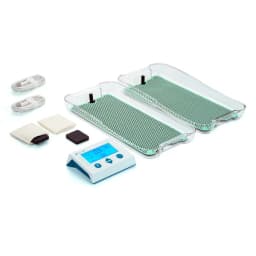
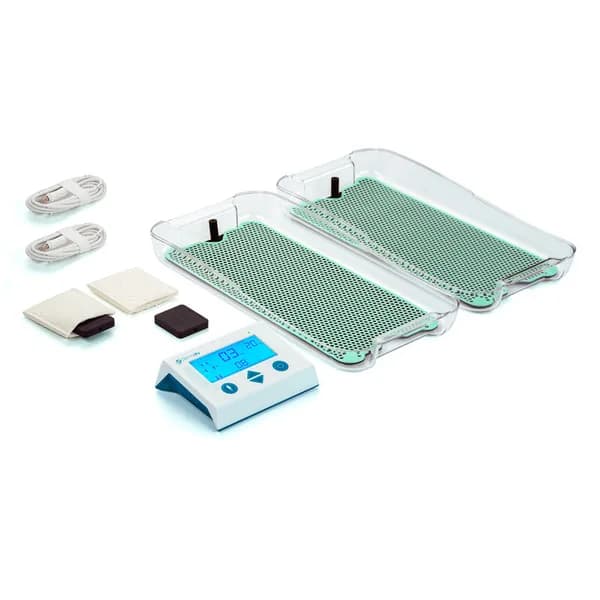
A typical session with Dermadry Total:
- Fill the trays with tap water
- Place hands (or feet) in the trays
- Turn on the device and set your intensity level
- Sit for 20 minutes while the current flows
- Remove hands, dry off, and you are done
Treatment schedule:
- Weeks 1-4: 3-5 sessions per week (building phase)
- Week 4+: 1-2 sessions per week (maintenance phase)
- Total time commitment: 60-100 minutes per week initially, dropping to 20-40 minutes
Botox: In-Office Injections
Botox works by blocking the neurotransmitter acetylcholine from reaching sweat glands. Without acetylcholine, the sweat glands cannot receive the nerve signal to activate.
A typical Botox session:
- Travel to your dermatologist's office
- The treatment area may be mapped with a starch-iodine test
- Topical numbing cream is applied (optional)
- 15-20 small injections per treatment area
- Go home immediately — no downtime
Treatment schedule:
- Every 4-9 months (most patients average 6 months)
- 2-3 office visits per year
Effectiveness by Treatment Area
Hands (Palmar Hyperhidrosis)
| Treatment | Effectiveness | Notes |
|---|---|---|
| Iontophoresis | substantial | Hands are the ideal treatment area for iontophoresis |
| Botox | substantial | Effective but injections into palms are painful |
Verdict for hands: Iontophoresis is better. It is more effective, less painful, and dramatically cheaper for hand treatment. Botox injections into the palms are notoriously painful (the palms are densely innervated), often require nerve blocks, and can cause temporary hand weakness.
Feet (Plantar Hyperhidrosis)
| Treatment | Effectiveness | Notes |
|---|---|---|
| Iontophoresis | substantial | Feet respond well but slightly slower than hands |
| Botox | substantial | Effective but foot injections are very painful |
Verdict for feet: Iontophoresis is better, for the same reasons as hands. Foot injections are extremely painful, and the thick skin on soles makes Botox delivery less consistent.
Underarms (Axillary Hyperhidrosis)
| Treatment | Effectiveness | Notes |
|---|---|---|
| Iontophoresis | Effective | Less effective for underarms; awkward positioning |
| Botox | Highly effective | The FDA-approved area; works excellently |
Verdict for underarms: Botox is better. Underarm Botox is the most-studied application, injections are relatively comfortable, and results are excellent. Iontophoresis can treat underarms (Dermadry includes underarm pads) but requires awkward body positioning and delivers weaker results.
Face (Craniofacial Hyperhidrosis)
| Treatment | Effectiveness | Notes |
|---|---|---|
| Iontophoresis | Not applicable | Cannot treat the face |
| Botox | substantial | Effective off-label treatment |
Verdict for face: Botox is the only option. Iontophoresis cannot be used on the face. See our facial sweating guide for more options.
Cost Over Time: The Full Financial Picture
Iontophoresis (Dermadry Total)
| Year | Cumulative Cost |
|---|---|
| 1 | $500 (about £372) (device purchase) |
| 2 | $500 (about £372) (no additional cost) |
| 3 | $500 (about £372) (replacement pads: ~$20-30 (about £15–22)) |
| 5 | ~$450 (about £335) total |
| 10 | ~$500 (about £372) total (pad replacements + potential new device) |
Botox (2-3 sessions/year)
| Year | Cumulative Cost (without insurance) | Cumulative Cost (with insurance) |
|---|---|---|
| 1 | $2,000-4,500 (about £1,487–3,347) | $200-900 (about £149–669) (US copays) |
| 2 | $4,000-9,000 (about £2,975–6,693) | $400-1,800 (about £297–1,339) |
| 3 | $6,000-13,500 (about £4,462–10,040) | $600-2,700 (about £446–2,008) |
| 5 | $10,000-22,500 (about £7,437–16,733) | $1,000-4,500 (about £744–3,347) |
| 10 | $20,000-45,000 (about £14,874–33,466) | $2,000-9,000 (about £1,487–6,693) |
Cost Verdict
Without insurance, iontophoresis is dramatically cheaper — by a factor of 40-90x over 10 years. Even with good insurance coverage, iontophoresis wins financially.
The exception: if your Integrated Care Board funds Botox on the NHS AND you need underarm treatment (where Botox outperforms iontophoresis), the cost calculation may favor Botox.
Convenience and Lifestyle
Iontophoresis: Time-Intensive but Flexible
Pros:
- Treat at home on your own schedule
- No doctor visits or appointments needed
- No needles or injections
- Watch TV or read during sessions
- No prescription required to purchase
Cons:
- Requires 20-minute sessions 3-5x per week initially
- Must maintain a regular schedule or results fade
- Takes 2-4 weeks to reach peak effectiveness
- Cannot skip a week without seeing decline
- Requires sitting still with hands/feet in water
Botox: Infrequent but Requires Clinic Visits
Pros:
- Only 2-3 office visits per year
- No daily or weekly maintenance
- Results last 4-9 months per session
- No home equipment or routine needed
- Results begin within days
Cons:
- Requires travel to a specialist
- Scheduling appointments can be difficult
- Injections are uncomfortable (especially in palms/feet)
- Need to find a provider experienced in hyperhidrosis Botox
- Some insurance requires prior authorization and documentation
Convenience Verdict
It depends on what type of convenience you value. If you prefer minimal ongoing effort and do not mind clinic visits every 6 months, Botox wins. If you prefer treating at home and avoiding doctors, iontophoresis wins. The total time investment is actually similar — iontophoresis requires more frequent but shorter time blocks, while Botox requires infrequent but involves travel, waiting rooms, and the injection process.
Side Effects
Iontophoresis
- Tingling during treatment — normal and expected; intensity is adjustable
- Skin dryness — mild dryness on treated areas; moisturize after sessions
- Skin irritation — uncommon; usually from intensity being set too high
- No systemic side effects — the electrical current is localized
Botox
- Injection-site pain — especially in palms and soles
- Temporary muscle weakness — possible in hands after palmar injections (can affect grip strength for 1-2 weeks)
- Compensatory sweating — some patients report increased sweating in untreated areas
- Bruising — minor bruising at injection sites
- Rare systemic effects — headache, flu-like symptoms (uncommon)
Side Effects Verdict
Iontophoresis has a significantly better side effect profile. The effects are localized, mild, and controllable (adjust intensity). Botox's most concerning side effect for hand treatment is temporary grip weakness, which can affect daily activities for 1-2 weeks after each session.
The Verdict: Who Should Choose What
Choose Iontophoresis If:
- Your primary problem is sweaty hands and/or feet
- You are comfortable with a regular at-home treatment routine
- Cost is a factor (especially without insurance)
- You want to avoid needles and clinic visits
- You prefer a treatment you can control yourself
- You want to start immediately without a prescription
Our recommendation: Dermadry Total at $500 (about £372) is the best at-home iontophoresis device.
Choose Botox If:
- Your primary problem is underarm sweating
- You need treatment for your face or scalp
- You prefer infrequent treatments over regular maintenance
- Your insurance covers Botox for hyperhidrosis
- You have already tried iontophoresis without sufficient results
- You want the strongest possible treatment for underarms
Use Both:
Many patients with multi-area hyperhidrosis benefit from combining treatments:
- Iontophoresis for hands and feet (where it excels and is cost-effective)
- Botox for underarms (where it outperforms iontophoresis)
- This combination provides excellent coverage across all major sweating areas
FAQ
Can iontophoresis replace Botox for underarms?
Iontophoresis can treat underarms, but results are weaker than with Botox. If your primary concern is underarm sweating and clinical antiperspirants are not enough, Botox is the better choice for that specific area.
Is iontophoresis painful?
No. Most users describe a mild tingling sensation that is easily tolerable. The Dermadry Total has adjustable intensity so you can start low and gradually increase to your comfort level.
How long do Botox results last for hands?
Botox in the palms typically lasts 4-6 months — slightly shorter than underarms (6-9 months). The thinner skin and higher nerve density in palms mean the Botox dissipates somewhat faster.
Can I switch between iontophoresis and Botox?
Yes. There is no conflict between the two treatments, and you can switch or combine them as needed. Some patients start with Botox, then transition to iontophoresis to save money, or vice versa.
Does my doctor need special training for hyperhidrosis Botox?
Look for a dermatologist who regularly treats hyperhidrosis with Botox — not just cosmetic Botox. The injection depth, pattern, and dosing differ from cosmetic applications. Ask how many hyperhidrosis patients they treat annually.
Sources
- International Hyperhidrosis Society — Iontophoresis and Botox treatment guidelines
- Dermadry — Clinical data on iontophoresis effectiveness
- Allergan — Botox (onabotulinumtoxinA) prescribing information
- Journal of the American Academy of Dermatology — Comparative hyperhidrosis treatment outcomes
- FDA — Botox approval for primary axillary hyperhidrosis